~ $ contents · 7 sections
- The Formula / System?
- 1. Learn the Uyir Ezhutukkal (Vowels) first.
- 2. Learn the Mei Ezhutukkal (Consonants) next.
- 3. Formation of Uyirmei Ezhuttukal (Compound Alphabets) next.
- 4. Letters for non-Tamil alphabets (Grantham Letters) - Used to represent non-native Tamil words, usage may not be very common
- 5. Final Notes / Tips / Rules
- Conclusion
Learn Tamil reading and writing, quick
If you can already speak and understand Tamil, here is the formula I use to teach reading and writing in a few sittings.
It's been a long dream for me to be able to read and write this beautiful language that I have been able to speak and understand since I was born. With this formula, I was able to quickly and finally (within a week or so of dedication), get this done. Also, ensure to read the entire article till the end as I have answered many common questions throughout. Enough of the waffle, lets get to business.
Note: My formula works quick! It may not be very "traditional" but you will be able to read and write eventually with this formula.
Note 2: Depending on what system font you have, the letters may be rendered differently. As such, refer to the images I've included to see the drawing format.
Note 3: I've referenced some images and some concepts, which I have highlighted the source in the "References" section.
Essentially, in Tamil, you have:
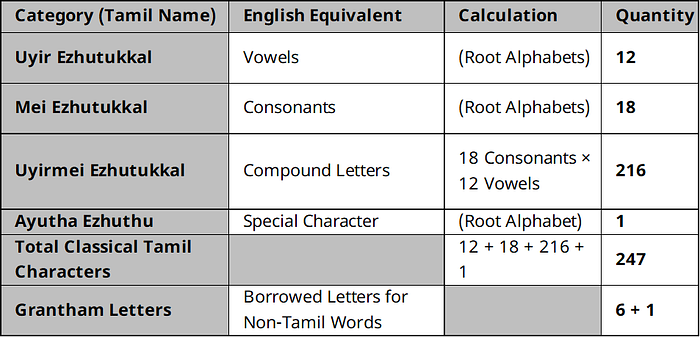
For this formula, learn how to draw the Uyir Ezhutukkal (Vowels) & Mei Ezhutukkal (Consonants) first. Learning the single Ayutha Ezhutu (ஃ) is easy. For the vowels (Uyir) and consonants (Mei), you can use these children's rhymes video. You can refer to Uyir Rhymes Video, Mei Rhymes Video 1 or Mei Rhymes Video 2 (It's not cringe if it works). Regardless, give the below a read before you start learning how to draw the 18 + 12 + 1 alphabets.
[0x01] The Formula / System?
For learning to draw the Uyir and Mei Ezhuthukkal in a fun way using mnemonics, I highly recommend this guide from Kyle Siemens: Click Here. Do give 1 & 2 a read through first before that.
[0x02] 1. Learn the Uyir Ezhutukkal (Vowels) first.

Try to use your own way to learn how to remember the letters. Eg aa has a doorknob-like circle below the "a", ai looks like a butterfly etc.
Refer to this excellent video on how to draw the Vowels: Vowel Drawing Guide
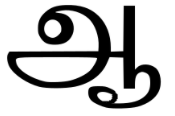
Note, I draw aa as per the image below. Digital fonts draw it the way shown in the table above, but for writing, I draw it as per below.
[0x03] 2. Learn the Mei Ezhutukkal (Consonants) next.
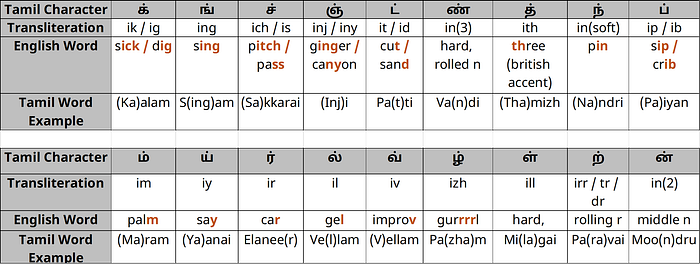
Refer to this excellent video on how to draw the Consonants: Consonants Drawing Guide. Above for the "Na" alphabets i put (2) and (3) referring to the number of loops. For the letters themselves you may have noticed that I have put multiple transliterations for some. The exact usage will depend on the context of the word itself. If the letters are hard to pronounce or wrap your head around, try to start off with this video: Click Here, and do look around on YouTube.
I recommend that you grasp each consonant's pronunciation, and learn to draw it first, along with the vowels as well first, before proceeding with the rest of the guide. The reason is that the Uyir and Mei Ezhutukkals are the key foundations to my formula. The alphabets, along with their pronunciations will take most of your time. Once you have this foundation, the rest of this guide should be smoother than butter.
Now what you may be wondering why are there dots above the Mei Ezhutukkal. Simple. Think of the character with a dot on top as the base / root alphabet, once you compound it with the Uyir Ezhutukkal then it will change. The next section (compound letters) will cover this. Below is a pronunciation breakdown for some confusing letters.
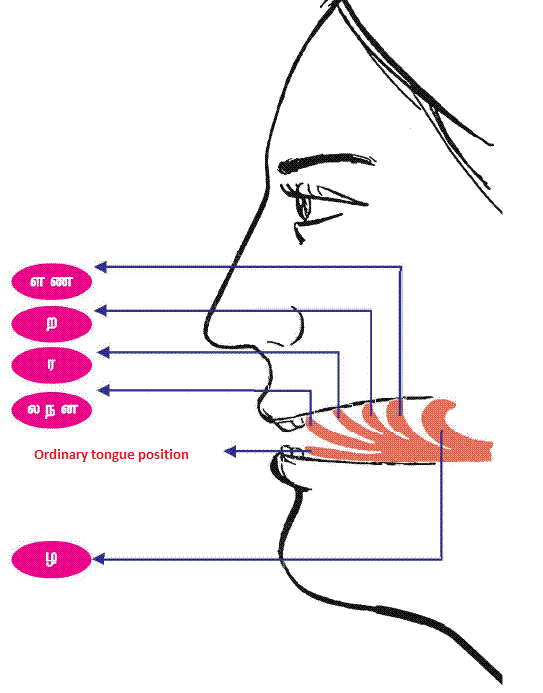
2.1. Some Consonent Families
2.1a: The Three 'Na's (ந, ன, ண):
- ந (na - soft): The "tooth na." Your tongue touches the back of your teeth. (example: நன்றி - nanri).
- ன (na (2) ): The "middle na." Your tongue position should be in between the ந (na) and ண (Na) (example: அவன் - avan).
- ண (na (3) ): The "rolled-tongue Na." Roll your tongue back to touch the roof of your mouth. (example: கண் - kan).
2.1b: The Two 'La's (ல, ள) and my love, the 'Zha' (ழ):
- ல (la): The normal 'l'. Your tongue touches the back of your teeth. (e.g., பால் - paal as in milk).
- ள (La): The rolled-tongue 'la'. Roll your tongue back to touch the roof of your mouth, while you make the la sound. (example: பள்ளி - palli as in school).
- The UNIQUE, GOATED, Sound: ழ (zha): Let's talk about this really special sound. It may seem like a challenge, and you'll often hear it replaced with la, but let's get it right.
- ழ.1: Start by making the ள (la) sound, where you roll your tongue to touch your palate. Now, do the exact same roll, but stop your tongue just before it touches the roof of your mouth, essentially placing it just slight below the roof.
- ழ.2 Trick: My favourite method comes from a meme I saw from a youtube video, which is to sound the ழ close to the way the Gen Z kids make the 'rrr' sound in the word "gurrrrl!"
2.1c: The 'Ra's (ர, ற):
- ர (ra): This is the soft, standard 'r' sound.
- ற (Ra): This letter is a special case with two sounds:
- Hard, Rolled 'R': On its own, its a strong, rolled 'R' sound, like in ஆறு (aaRu - river/six).
- Hard 'tra': When doubled (ற்ற), it becomes a hard 'tra' / 'dra' sound, like in சுற்று (suttru - to rotate) or வெற்றி (vettri - victory).
2.1d: Position Summary
[0x05] 3. Formation of Uyirmei Ezhuttukal (Compound Alphabets) next.
Ok the fun part, this is where my formula kicks in. Basically, for the compound letters, you are adding the Uyir (Vowels) to the Mei (Consonants). From learning the Uyir and Mei letters so far, how would you write a word like "thevai" (necessary) or "aamai" (tortoise)?
The Golden Rule:
- When a consonant comes before a vowel (like th - ey & iv + ai in thevai), you MUST combine them into a single compound letter. த் + ஏ= தே and வ் + ஐ = வை.
- When a vowel sound comes first (like aa-m-ai), you just write the vowel as is, then write the next compound letter. ஆ then ம் + ஐ = மை.
TLDR: You compound when the vowel comes after the consonant. You will get this with practice, but for a start, always start by splitting each letter by its syllable, then follow the aforementioned golden rules.
Formula to write Compound Letters (a to l) - For all, please remove the dot on top, I won't mention it after 3a. Furthermore, this section will provide the key formula only, the detailed chart of characters will follow after this.
3a. Compounds of அ: Just remove the dot on top of the consonants. Example: த் + அ = த
3b: Compounds of ஆ: add (ா) after the consonant. Eg: த் + ஆ = தா
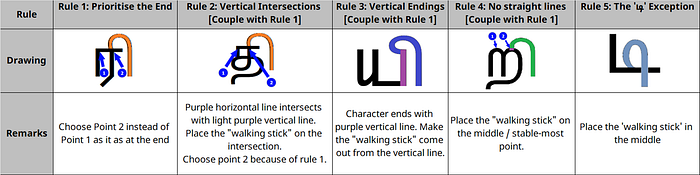
3c. Compounds of இ: add the( ி ), I call it the "walking stick", as per the following rules (1-5):
3c Rule 1: Prioritization: Rules 2-4 prioritize placing the 'walking stick' at the end most intersection / line. For the curve, choose the point that is most stable (middle of curve).
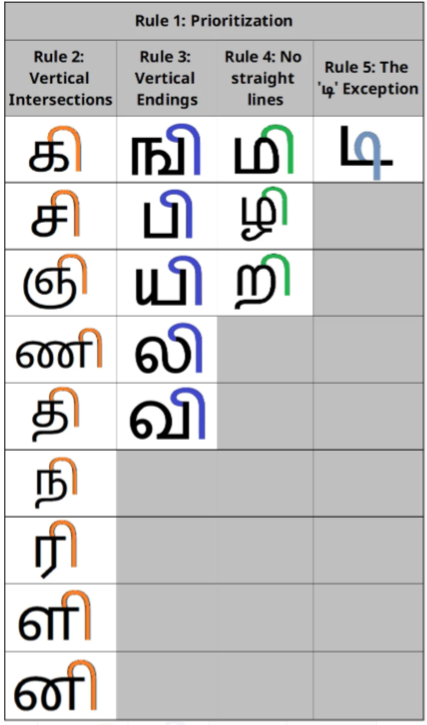
3c Rule 2: Vertical Intersections [Couple with rule 1]: If a character's vertical line intersects a horizontal line, place the 'walking stick' at the intersection. (Applies to கி சி ஞி ணி தி நி ரி ளி னி). The font may make it look kind of inaccurate, but follow my upcoming drawings for a clear picture.
3c Rule 3: Vertical Endings [Couple with rule 1]: If the character ends with a vertical line, place the 'walking stick' on top of that line. The font may show the stroke as slightly left to the vertical line, but you may draw either way. This rule applies to ஙி பி யி வி. Exception: For 'லி', which ends with a curved line at the end, still apply this rule.
3c Rule 4: No straight lines [Couple with rule 1]: If there are no vertical or horizontal lines, place the 'walking stick' in the middle of the top curve (applies to மி ழி றி). The way to remember this is that, you put the "walking stick" in the middle as it is the most stable.
3c Rule 5: The 'டி' Exception: The 'டி' letter is an exception; place the 'walking stick' in the middle, similar to Rule 3 but with unique positioning.
Summary of Rule 1-5 & The resulting characters are as follows:
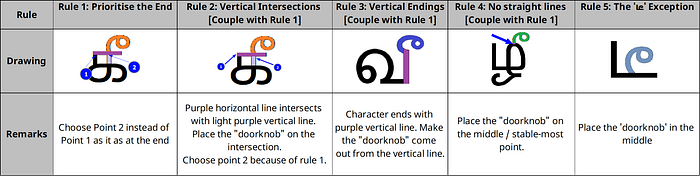
3d. Compounds of ஈ: add the ( ீ ), I call it the "doorknob", as per the following rules (1-5): NOTE: The rules are exactly the same as 3c, but you put the "doorknob" instead of the "walking stick"
3d Rule 1: Prioritization Rules 2-4 prioritize placing the 'doorknob' at the endmost intersection / line. For the curve, choose the point that is most stable (middle of curve).
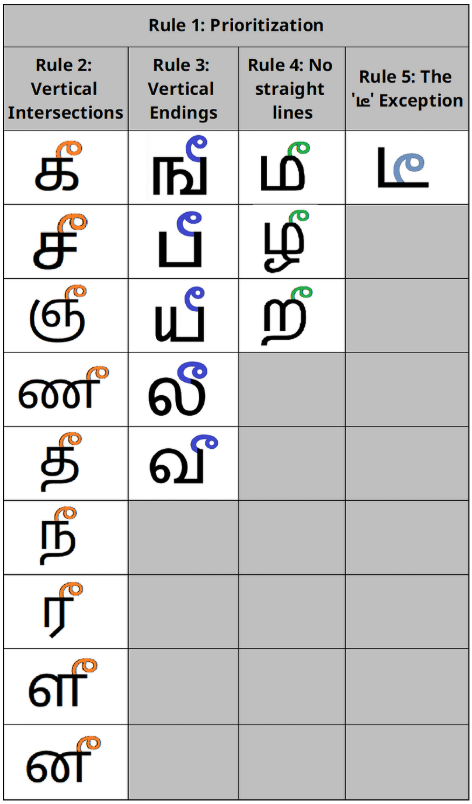
3d Rule 2: Vertical Intersections [Couple with rule 1] If a character's vertical line intersects a horizontal line, place the 'doorknob' at the intersection. (Applies to கீ, சீ, ஞீ, ணீ, தீ, நீ, ரீ, ளீ, னீ). The font may make it look kind of inaccurate, but follow my upcoming drawings for a clear picture.
3d Rule 3: Vertical Endings [Couple with rule 1] If the character ends with a vertical line, place the 'doorknob' on top of that line. The font may show the stroke as slightly left to the vertical line, but you may draw either way. This rule applies to ஙீ, பீ, யீ, வீ. Exception: For 'லீ', which ends with a curved line at the end, still apply this rule.
3d Rule 4: No straight lines [Couple with rule 1] If there are no vertical or horizontal lines, place the 'doorknob' in the middle of the top curve (applies to மீ, ழீ, றீ). The way to remember this is that, you put the "doorknob" in the middle as it is the most stable.
3d Rule 5: The 'டீ' Exception The 'டீ' letter is an exception; place the 'doorknob' in the middle, similar to Rule 3 but with unique positioning.
Summary of Rule 1-5 & The resulting characters are as follows:
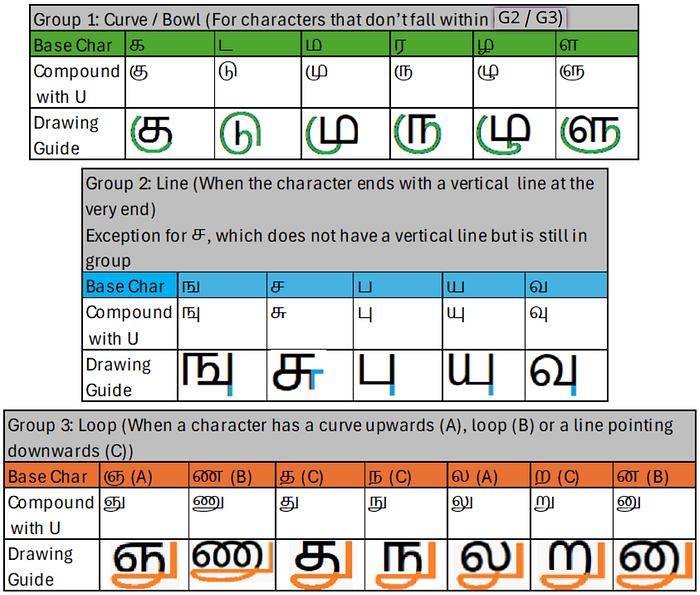
3e. Follow Below Tables :)
Group 1: Draw a Curve / Ball-like structure, Group 2: Draw a line downwards, and Group 3: Loop, then have a vertical line
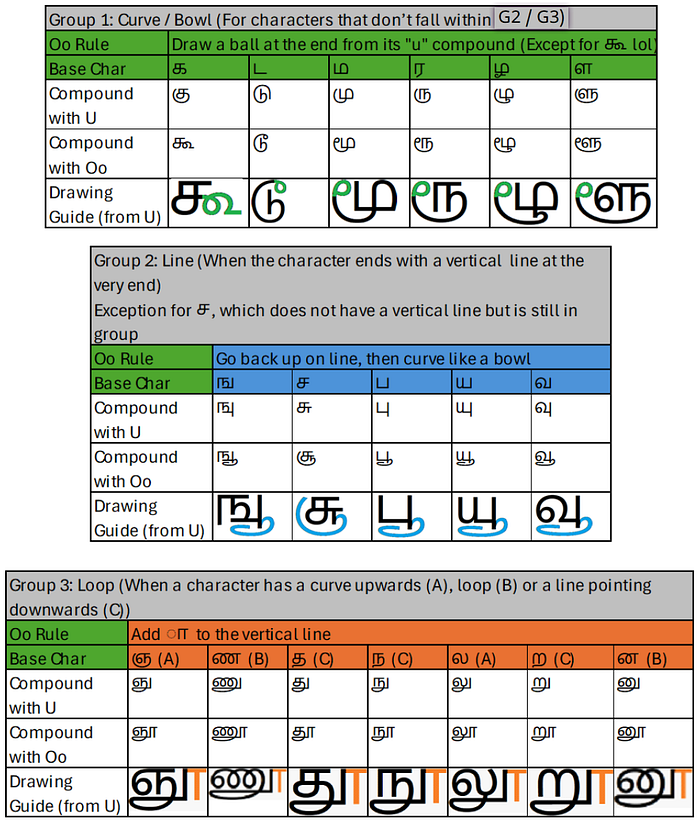
3f. Follow Below Tables :)
Group 1: Draw a ball at the end of the corresponding "u" compound character except for கூ, Group 2: Go back up on the vertical line, then curve like a bowl, except for சூ, where you curve all the way till the top left, near the beginning of the alphabet, Group 3: Add ா to the vertical line
3g. Compounds of எ: add (ெ) before the consonant. Eg: ப் + எ = பெ
3h. Compounds of ஏ: add (ே) before the consonant. Eg: ப் + ஏ = பே
3i. Compounds of ஐ: add (ை) before the consonants. Eg: ப் + ஐ = பை
3j. Compounds of ஒ (o): Formula: ெ + [Consonant] + ா Example: ெ + க + ா → கொ (ko)
3k. Compounds of ஓ (ow): Formula: ே + [Consonant] + ா Example: ே + க + ா → கோ (ko [long o])
3l. Compounds of ஔ (au): Formula: ெ + [Consonant] + ள Example: ெ + க + ள → கௌ (kau)
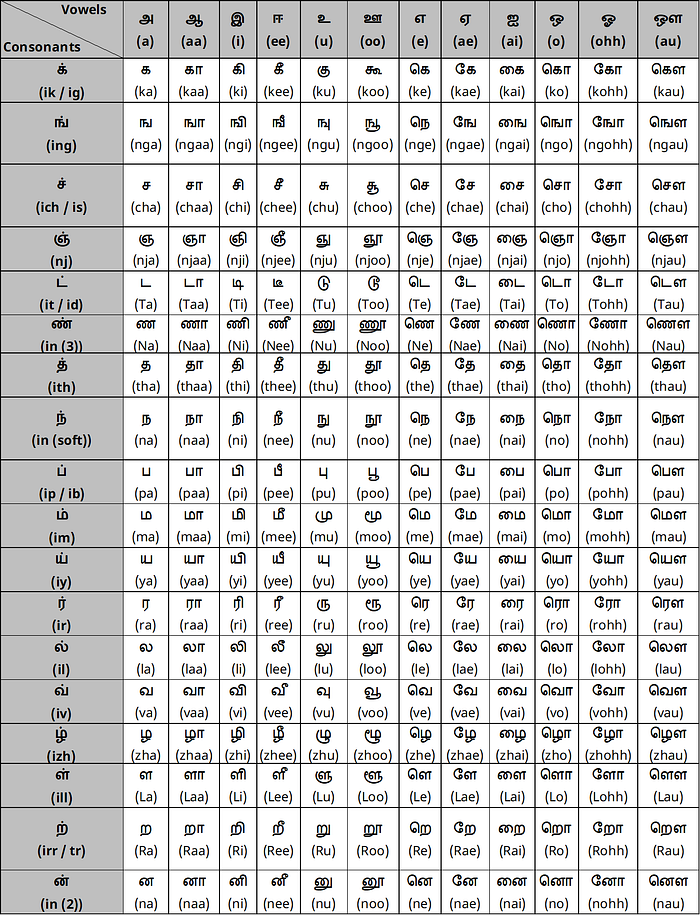
Below is a summary of the UyirMei Ezhutukkal:
[0x07] 4. Letters for non-Tamil alphabets (Grantham Letters) - Used to represent non-native Tamil words, usage may not be very common
Refer to this excellent video on how to draw the Grantham Letters: Grantham Letters Drawing Guide
4a. Grantham Letter List
- ஸ - sa, pronounced as the s in "Sanskrit", (Think of it as drawing the lla (ள)) but curve both strokes except the end which comes the other way round. The thing is, though it is pronounced "sa", but you would still use the ச for Tamil words, and ஸ for Sanskrit-based / English words.
- ஜ - ja, pronounced as the ja in "japan", (Think of it as drawing ai (ஐ but the bottom part is not w, instead it curves back)
- ஷ & ஶ -> DISCLAIMER: People usually just pronounce both as "sha" - as in "sharon" and the usage of the "ஶ" alphabet in Tamizh is very limited. However, I have included the proper explanations of what both alphabets are supposed to be, but do note that you will mostly only see ஷ as in "sha"ron.
- ஷ - sha (Think of it as drawing va (வ) plus an extended walking stick (ி) You should roll your tongue while saying this sha, similar to how you roll your tongue when you say lla (ள)
- ஶ - sha (This alphabet is drawn like two u's with a line connecting from the end of the first u to the end of the second u) You pronounce this like the sha in "sharon",
- ஹ - ha, pronounced as the ha in "hand", (Think of it as drawing va (வ) without the last vertical line, plus rra (ற) with a long curve under
- க்ஷ - ksha (Think of it as drawing sa (ச) plus sha(ஷ) coming out of it
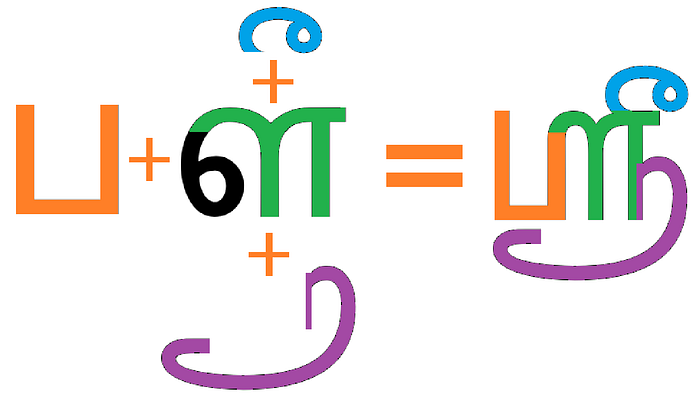
- ஸ்ரீ - shree (This is essentially like drawing pa + lla (ள) + loop under + ee compound ( ீ) on top). Note1: This letter is a compound of ஶ + ீ. Note 2: System fonts usually generate this in a odd way, refer to my drawing below, which shows how I draw it (but does not refer to how the letter itself is constructed):
4b. Grantham Compounds
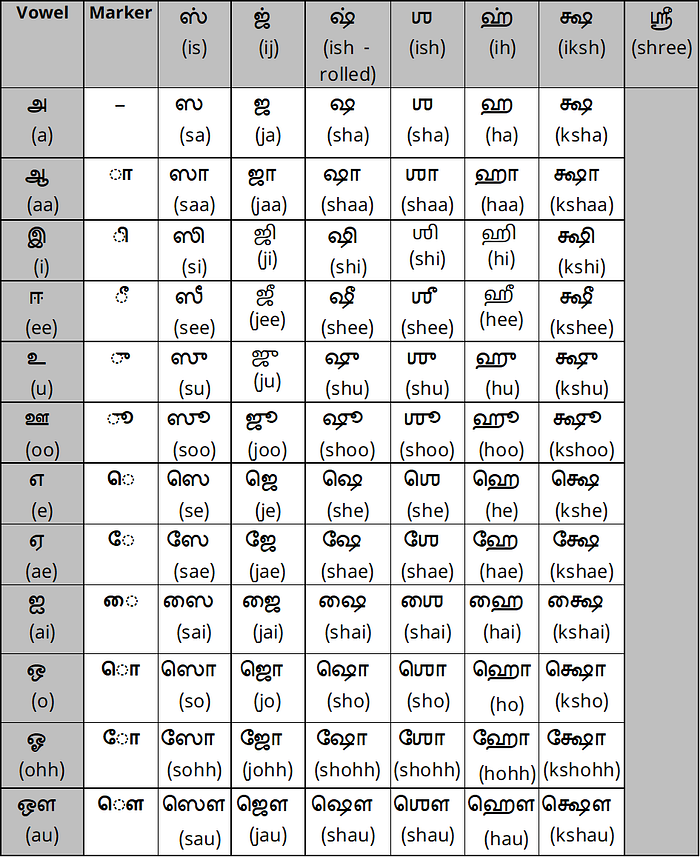
While Grantham letters also form vowel compounds, the good news is that you can carry over whatever you have learnt in section 3) Compounding for Uyirmei Ezhuthukkal. The added benefit with the Grantham letters is that, you just need to add the vowel marker to the consonant without changing its original shape, making it super easy.
For instance, when adding the 'u' (உ) and 'oo' (ஊ) vowels. Instead of changing the characters , you just add the ு and ூ markers directly. For example, ஷ் (sha) + உ (u) becomes ஷு (shu). This is a much easier pattern than the earlier system for the uyirmei ezhuthukkal, where க் + உ becomes கு.
4c. Final Points for Grantham Letters
- The ஸ்ரீ Exception: The character ஸ்ரீ (Shri) is a special case. It does not compound with other vowels because it in itself is already a compound letter. Bros kinda on his own.
- Essentially, if you understand the formula for compounding as per my earlier sections, and you follow those rules, except the modified case here for 'u' (உ) and 'oo' (ஊ) compounds, you are actually set.
- What is the "Marker": In the table below, the 'vowel marker' is the sign that gets added to the base Grantham letter to create the new compound alphabet and resulting sound.
[0x08] 5. Final Notes / Tips / Rules
You've learned the powerful formulas above. Let's go through some basic rules / tips that will help connect what we've learnt to the language itself. This are some general rules, however as I am still learning, I will do a separate guide on this in the future.
5.1. Letters That Can't Start a Word:
- The consonants ள, ழ, ற, ன, ண, ங can never be the first letter of a word. If a word starts with 'R' (like 'Rama'), or some of the other listed consonants, sometimes an 'i' sound to the front: இராமர் (iramar). However there may be some exceptions.
- Cannot end a word: ந
- For ந, you generally don't find it in the middle of a word. However, you may see its root form, ந் in the middle of the word. This can be seen in words that have sounds like "indh" in it, where then it will come before the "tha" (த). Example: சுந்தரம் (Sundharam). This is the reason you see the letter sometimes being called "indh".
5.2. Sound Hacks and Special Rules
5.2a: Making the 'F' sound
Tamil does not natively have the 'f' sound, so we use the Ayutha Ezhuttu, ஃ, together with a ப (pa) to draw this sound.
- Example: காஃபீ (kaa-fee); the fee : ஃ + பீ = ஃபீ.
- Same applies to words / names like Saif, it will be சை (sei) + ஃப் (ip) = சைஃப்
- Rule of Thumb for the 'F' sound: Just use pa or ip alphabet, then add the Ayutha Ezhuttu (ஃ) in front, then you are Done!
5.2b: Writing "Joined" Letters (like in Priya or Krishna)
- Seems difficult? No worries, let us break it down as you may see it written two different ways. You might see கிருishna or க்ருishna, where both are pronounced as Krishna. Whats going on?
Case 1: Compounding with இ (i) + Next Compound Alphabet
- You will see this done more often compared to Case 2. Essentially, you "split" the joined sound, to become two alphabets, where the first letter is joined with a இ (i), and the second part is retained. For instance:
- The sound "Pra" becomes "Pira". You write it as: பி + ர.
- The sound "Kru" becomes "Kiru". You write it as: கி + ரு.
Case 2: First Root Alphabet + Next Compound Alphabet:
- In other cases, you may see the letters written, just like in the example ப்ரம்மம் (Brahmam).
- Here, the first consonant stays in its root form with a dot on top, ip (ப்), and the second compound letter attaches to it. So, ip + ra becomes ப்ர. ik+ ru becomes க்ரு.
Case 1 is more popular, although I prefer case 2, but do feel free to use any
TLDR: So a word like Brahmam it can be written in either one of the cases: Case 1 -> பிரம்மம் OR Case 2 -> ப்ரம்மம்
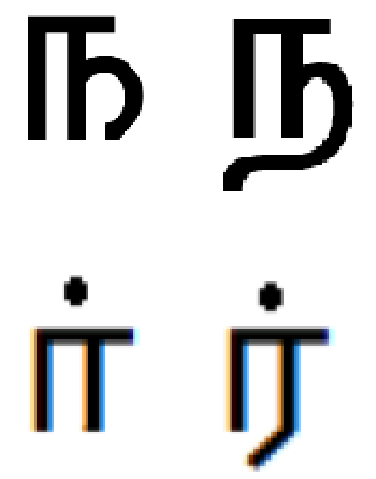
5.3. You will sometimes see some differently written / older forms of the letters written, here is one that I remember, specifically the na and the ra letters; there may be more that I have missed:
5.4. Start reading and writing Tamil on your phone
On your phone, you have a couple of options:
Option 1: English -> Tamil Keyboard: Where you type in English and it transliterates to Tamil
Option 2: Native Tamil Keyboard where you type the individual letters to compound them
Option 3: Handwritten Keyboard: Drawing the alphabets themselves which will then show up as text
Option 4: Skip the phone and just write on paper lol
[0x0D] Conclusion
Wait what, that's it? Yeah that is pretty much all you need to read and write Tamil! Of course spelling words and all are a different matter, but now you should be able to kinda basically read and write! That was nice. Keep practicing and you will get it real quick. Vaazhga Tamizh! வாழ்க தமிழ்!
I am planning on doing a separate guide on some spelling / grammar rules to build from what I have started in the Final Notes section. LMK If you guys are interested.
References
- https://ilearntamil.com/tamil-alphabets-chart/
- https://www.koreascience.kr/article/JAKO202421243283916.pdf
- https://www.youtube.com/watch?v=GqbLovThG0I&t=2263s
- https://ta.wikipedia.org/wiki/%E0%AE%AA%E0%AE%9F%E0%AE%BF%E0%AE%AE%E0%AE%AE%E0%AF%8D:Tamil-alphabet-%E0%AE%86%E0%AE%86.svg
- https://web.archive.org/web/20120311223833/http://www.leonidas.org/rdg/matd/dissertation/FernandoMello_dissertation.pdf
- https://www.youtube.com/watch?v=pAyOEMjrF0k
- https://www.learntamil.com/part1/intro/thamil-alphabet/#beginning-a-word
- https://www.tumblr.com/logic10/25302495177/shrisri-%E0%AE%B8-%E0%AE%B0-%E0%AE%B6-%E0%AE%B0-%E0%AE%B8-%E0%AE%B0
- https://www.reddit.com/r/tamil/comments/1be0yp9/is_this_%E0%AE%B6_an_old_letter/
- https://www.reddit.com/r/linguistics/comments/hwm2rn/%C9%95_vs_%CA%82/
- https://learntamilfreeonline.blogspot.com/2012/11/consonantal-vowels-first-set.html
- Gemini (AI Studio) & ChatGPT - Helping me structure some stuff